
A Network of City Justice Courts
Utah County runs its city cases through a patchwork of municipal Justice Courts. Each one keeps its own files and clerk rules. Utah County's Sheriff posts a Pay Warrants form listing Alpine, Genola, Goshen, Highland, Lehi, Lindon, Mapleton, Orem, Payson, Pleasant Grove, Provo, Santaquin, Saratoga Springs, and Springville among its court choices. That selector helps route a payment. It is not a warrant search. These courts hear city traffic matters, infractions, ordinance violations, and class B/C misdemeanors, while felony and class A cases usually land in the Fourth District. Pin down where the case sits before you pick up the phone. The Utah State Court Directory carries current contact details for every one of them.
Utah County Municipal Court Warrants
A Utah County municipal warrant is an order from a city Justice Court, often after a traffic or ordinance case reaches a failure-to-appear step. Utah sources call these bench or FTA warrants. The phrase "capias pro fine" is not used. The city clerk controls the case status. That clerk decides whether a payment, a reset, or an appearance will satisfy the order. City police may serve a warrant. A police report request does not recall the court order. After court entry, the warrant may feed into the statewide SWW file, so search there for a possible record, then call the named city clerk in Utah County for the exact status and amount.
The Sheriff Dropdown Names Each Court
Utah County's Sheriff runs a Pay Warrants form. It asks you to pick an issuing court from a dropdown of municipal courts plus an "OTHER" option, and it also requires a warrant or case number, the amount, and a note. Payment goes through after an office confirms the details. Not every city warrant can be paid there. And payment alone does not end a case. Use it only when the city clerk or the Sheriff's warrant team confirms the court and the amount. A wrong dropdown choice can delay routing. Ask whether a service fee is added, whether the payment lifts the warrant, and whether the city judge still requires an appearance. The Payson Justice Court page shows one Utah County city's clerk and hearing routes; the court name you select still controls where the money goes.
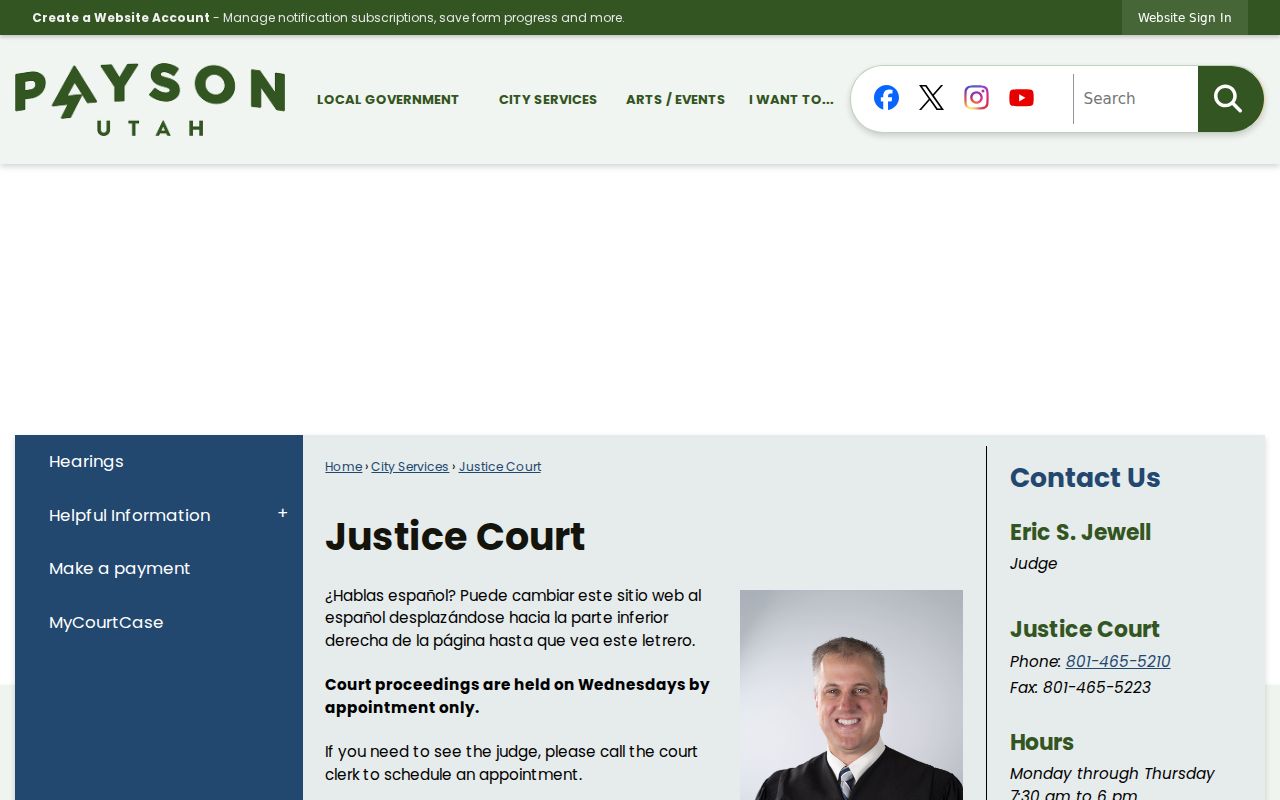
The Payson Justice Court page shows how one Utah County city routes clerk questions and hearing requests.
Utah County Cities With Municipal Courts
The Sheriff's form maps a wide court network, not one countywide city docket. Each city clerk sets its own terms. Some cases are payable outright. Others need a judge's request or a set hearing. Provo, Orem, Lehi, Spanish Fork, and Springville lead Utah County in population, and the other listed municipalities issue their own cases too.
| City court | Typical local matters | Routing note |
|---|---|---|
| Provo City Justice Court | Traffic, infractions, ordinances, class B/C matters | 75 E 1700 S, Suite 100; 801-852-6878 |
| Orem City Justice Court | Traffic and city criminal or ordinance cases | 97 E Center; 801-724-3900 |
| Lehi Justice Court | Traffic and city matters | 154 N Center; 385-201-1090 |
| Payson Justice Court | City traffic and criminal cases | Use official city court page; hearings by appointment |
| Other municipal courts | City traffic, ordinance, infraction matters | Verify current clerk through State Court Directory |
Confirm a court's current address before you visit. Utah County posts no dependable online contacts for the Spanish Fork and Springville courts.
Why a City Warrant May Be Missing
No Utah County city among Provo, Orem, Lehi, Spanish Fork, and Springville posts a public warrant roster. That silence proves nothing. A court can hold an active bench warrant with no public list anywhere. Utah's state search depends on court entry and removal. A lower-court event may not show at once. Juvenile, private, protected, or sealed rules can also restrict a city record. Search the public SWW file and XChange. Then call that city's municipal clerk. The Sheriff answers Utah County service questions, but the city court decides its own warrant, payment, and reset terms, and a no-hit statewide result still merits a clerk call when a citation or notice points to a case.
Checking a Municipal Court Warrant
Start with your citation or summons. Take the city and case number it shows. Search the state warrant file by name. XChange may then surface a public case summary for that case, and for your own case, MyCourtCase can show papers and balances after registration, though neither tool replaces the local clerk's word on whether a Utah County warrant is still active.
- Identify the city court printed on the citation or record.
- Search the official statewide warrant file using your first and last name.
- Call the court clerk with the citation or case number and ask about active status.
- Ask if the court requires payment, a judge request, a reset, or an appearance.
- After the court action, confirm the clerk reported the status update.
If you cannot pin down a city case, the State Court Directory can point you to the right Utah County department.
Provo, Orem, and Lehi Have Separate Rules
Utah County's big three cities each write their own rules. Provo tells citation holders to contact the court within five days, warning that delay can add fees or lead to a warrant. Orem says a delinquent citation or warrant may block a request or bring enhancement fees, and its judge form is defendant-only. Lehi warns of a possible warrant. A license suspension can follow an unaddressed citation. Their payment and judge-request routes differ. Call the local clerk before filing anything, because no form guarantees that an active warrant can be recalled without judicial approval.
Inside a Municipal Court Warrant
A Utah County city court file may hold the case number, the citation event, the missed appearance, the warrant entry, a balance, and later court action. Public labels vary from city to city. The clerk can decode them. What looks like an active bench warrant may in fact be a scheduled hearing, a payment balance, or a completed recall.
| City / court | Identifies the local court whose clerk controls the case. |
|---|---|
| Case / citation | Use the number printed on the ticket or court paper. |
| Warrant event | Can follow a missed date or failure to respond. |
| Amount | May be a fine, fee, or bond. Confirm the category. |
| Later action | May show payment, reset, service, or recall in court history. |
Utah County cities follow no shared warrant-number format. Whatever the clerk or the search result displays, copy it exactly when you ask about a municipal warrant.
Springville Details Need Fresh Confirmation
Utah County's Springville Justice Court handles local traffic and other justice matters, and its own forms show how that works. One older document, a 2014 bail schedule, says a signed citation should be presented within 20 days, but those dollar amounts are stale and should never be treated as the current balance on an active warrant. A newer plea-in-abeyance application from the court is more useful. It lists a $25 program fee, spells out eligibility rules, and requires a 90-day certificate. For a warrant check, current address, phone number, or payment instructions, contact Springville Justice Court through the State Court Directory rather than guessing from an old fine table. If you cannot reach the court, Utah County Justice Court or the Sheriff can point you to the right jurisdiction. Neither office, though, can decide a city judge's order. Only the issuing court can do that. Ask Springville directly.
How to Resolve a Municipal Court Warrant
Start with a phone call to the city clerk before you pay anything or show up anywhere. Ask three things: whether the matter can simply be paid, whether a judge must approve a reset, and whether the warrant carries an amount separate from the original citation. Some Utah County courts offer a request-to-judge form. If so, ask who may file it and which case number and details it needs. Once you act, keep every document. That means the payment receipt, the hearing notice, or the signed order. Then call the clerk back and confirm the warrant was actually recalled and that no appearance remains on the case. A promise to appear can leave a bench warrant active until the new date arrives. If the warrant must be served or a surrender is required, contact the Sheriff's team to arrange it. Never assume a payment alone closed anything in Utah County; the clerk's records settle the question.
City court payment rules differ. Do not use a county payment page unless the clerk confirms it accepts that exact municipal case.
Utah County's warrant records overview explains how city, county, and Fourth District records connect.
City Police and Court Are Different Records Holders
City police and city courts keep different records in Utah County, and mixing them up wastes time. A GRAMA request to a police department can get you an agency report, but no police officer or records clerk can touch a court warrant. Recall and hearings belong to the Justice Court clerk. Provo and Lehi each publish their own separate police records routes. For a court docket, use XChange or the municipal clerk. For a police report, use city records staff. For county service or extradition, turn to the Utah County Sheriff.
Resolving City Warrants After Payment
Paying off a city warrant does not always wipe it from the system right away. SWW updates on the court's schedule, not yours. Ask the city clerk when the update will be sent and whether another hearing remains on the case. If the record still shows after your court action, call with your receipt date and case number in hand. Also check any license suspension separately through Driver License Division. Clearing the warrant does not establish that the license record changed.